
Henderson County Supervision Types
Three labels can place a person under North Carolina Community Supervision, but they do not tell the same story. Probation is a court-ordered community sentence and does not establish that the person left prison. Parole is conditional release before sentence expiration for an eligible sentence, chiefly an older or exceptional sentence. Post-release supervision, often shortened to PRS, follows release from prison for covered Structured Sentencing cases. The North Carolina Department of Adult Correction, or NCDAC, handles field supervision. The North Carolina Post-Release Supervision and Parole Commission makes the release and supervision decisions assigned to it by law.
A current Henderson County jail roster cannot answer which status applies. A blank local lookup may reflect release, transfer, lag, or a name mismatch. The state offender record should be read in two parts: incarceration status and Probation/Parole/Post Release Status. Someone can be inactive as an inmate while active under supervision. Conversely, active probation does not prove a prior prison term.
| Status | How it begins | What it establishes |
|---|---|---|
| Probation | A court judgment imposes community supervision. | The person has court-ordered supervision, not necessarily a prison release. |
| Parole | The Commission conditionally releases a person serving a parole-eligible sentence. | The person left prison subject to parole terms. |
| Post-release supervision | State law places a covered prisoner on PRS before the maximum term ends. | The person is out of prison custody but has not reached unconditional discharge. |
- Discharge
- The formal end of a custody or supervision episode.
- Absconder
- A person alleged to have stopped reporting or complying with supervision.
- Detainer
- A request or legal basis for another authority to take or keep custody.
Verify Henderson County Supervision
The best public starting point is the NCDAC Offender Search. It covers state prison and Community Supervision records, not a county-jail-only history. An offender number is safer than a name because aliases and shared names can produce several candidates. Match the person before reading any status. The detailed record, rather than a search-result row, is where incarceration and supervision entries can be separated.
- Choose the Active Probationer/Parolee category or a broader category if the present status is uncertain. Search by the seven-digit offender number when available.
- When searching by name, add identifying details only as needed. Open the likely match and verify the offender number, identity, and record history.
- Read Inmate Status separately from Probation/Parole/Post Release Status. Preserve the official label instead of calling every community status parole.
- Review incarceration and sentence history to determine whether the supervision followed prison, came from probation, or relates to an older parole-eligible term.
- Use the NCDAC Community Supervision directory or the supervising officer’s instructions to confirm the office and any public status detail.
If documentary proof of a Henderson County court order is needed, match the state record to the Henderson case through eCourts or the Clerk. A court judgment can establish probation or the sentence behind supervision. It does not replace the NCDAC record of current compliance or discharge. The broader Henderson County released inmate search explains how the jail, court, and state records fit together.
Note: Record the date of observation because active supervision, incarceration, and discharge status can change after a public search.
Henderson County Supervision Contacts
NCDAC Community Supervision administers field work for Henderson County. Research did not verify a current Henderson reporting-office address, so no street address should be inferred from an old directory or a general map. A person under supervision should follow the officer-provided location and schedule. Someone trying to verify a public status can use the official directory and provide the offender number, while respecting limits on what staff may disclose.
Use the official field-office directory for the Henderson County unit.
Community Supervision office path
The Commission is a different contact. It handles statutory release and supervision decisions, not routine local reporting. Its administrative office is at 214 West Jones Street in Raleigh, with mail directed to 5201 Mail Service Center, Raleigh, NC 27699-5201. The published phone number is 919-733-2126, and Relay/TTY is 919-866-3665. Those details come from the Commission’s administrative functions page. They do not substitute for a supervisee’s assigned officer.
Henderson County Absconder Status
An absconder listing is a serious status lead, but it is not proof that a person is currently at large. NCDAC describes an absconder as someone alleged to have stopped reporting or complying. A supervision warrant may result in arrest and return to custody. That allegation does not create a new conviction on its own, and it should not be paraphrased as one.
The official NCDAC absconder list carries a vital warning: a listed person may already be incarcerated in another jurisdiction or may be deceased, and removal can lag by days or weeks. Check the current NCDAC person record, local jail status, and relevant court file before stating where someone is. A transfer or arrest elsewhere may not appear in the Henderson County source at the same time.
Henderson Supervision Changes and Discharge
Conditions vary with the judgment, release authority, and case. At a high level, supervision can require reporting and compliance with Commission or court terms. A claimed violation can lead to investigation, a warrant, a hearing process, modified conditions, or re-custody, depending on the status and law. Public records should be quoted with care. “Violation alleged,” “warrant issued,” and “revoked” are distinct events.
Supervision ends through an official discharge or other authorized termination, not merely because a person no longer appears on one screen. Read the NCDAC status and date fields in context. For parole or PRS, the Commission’s action and NCDAC supervision history can establish the end of the state episode. For probation, the court file may also show completion, modification, or revocation. NC SAVAN/VINELink can relay participating supervision changes, but an alert is supplemental and can lag.
Release from prison and discharge from supervision are also separate milestones. A person may have an Actual Release Date for incarceration while the supervision field stays active. That record supports “out of NCDAC prison and under community supervision,” not unconditional sentence completion. A later local, federal, or out-of-state arrest still requires a search of the relevant custodian.
Note: Use the precise NCDAC status label because “inactive inmate” and “off supervision” answer two different questions.
Henderson County Parole File Review
Ordinary North Carolina parole review is file-based. The Post-Release Supervision and Parole Commission says there is no formal hearing or personal meeting with the offender in the usual process. Commissioners independently review the file and vote. A narrow juvenile-life process may include a video appearance, but that exception should not be turned into a general Henderson County hearing calendar.
Eligibility comes from the sentence law and era, not an ordinary application. Structured Sentencing generally abolished parole for covered offenses committed on or after October 1, 1994. Older and exceptional cases can fall under routes in G.S. 15A-1371. Offense name alone is not enough to calculate eligibility. Sentence dates, judgment terms, credits, and the applicable statute matter.
Henderson Parole Decisions Are Retrospective
The Commission’s public channel is its monthly discretionary parole review files. When research was checked, files began with September 2024 and extended through June 2026. They report decisions already made. They are not a calendar of future offender hearings.
Outcome wording matters. Regular Parole, Community Service Parole, Early Medical Release, and 90-Day Mandatory Parole describe specific results. “Incomplete Decision” means more information or investigation was needed, not that parole was denied. “Suspend Decision” means further consideration stopped in stated circumstances. Commission records are generally confidential, and publication of monthly results does not waive that confidentiality. The official file and the NCDAC person record should be used together, since a decision result and current supervision status answer different questions.
The Commission notes that review can recur annually or every two or three years depending on the crime. That does not create a public appointment date. For a Henderson County person, use the monthly result after it is posted and ask the Commission only for information it can lawfully release.
The official Commission process page is visible in the matching source capture:
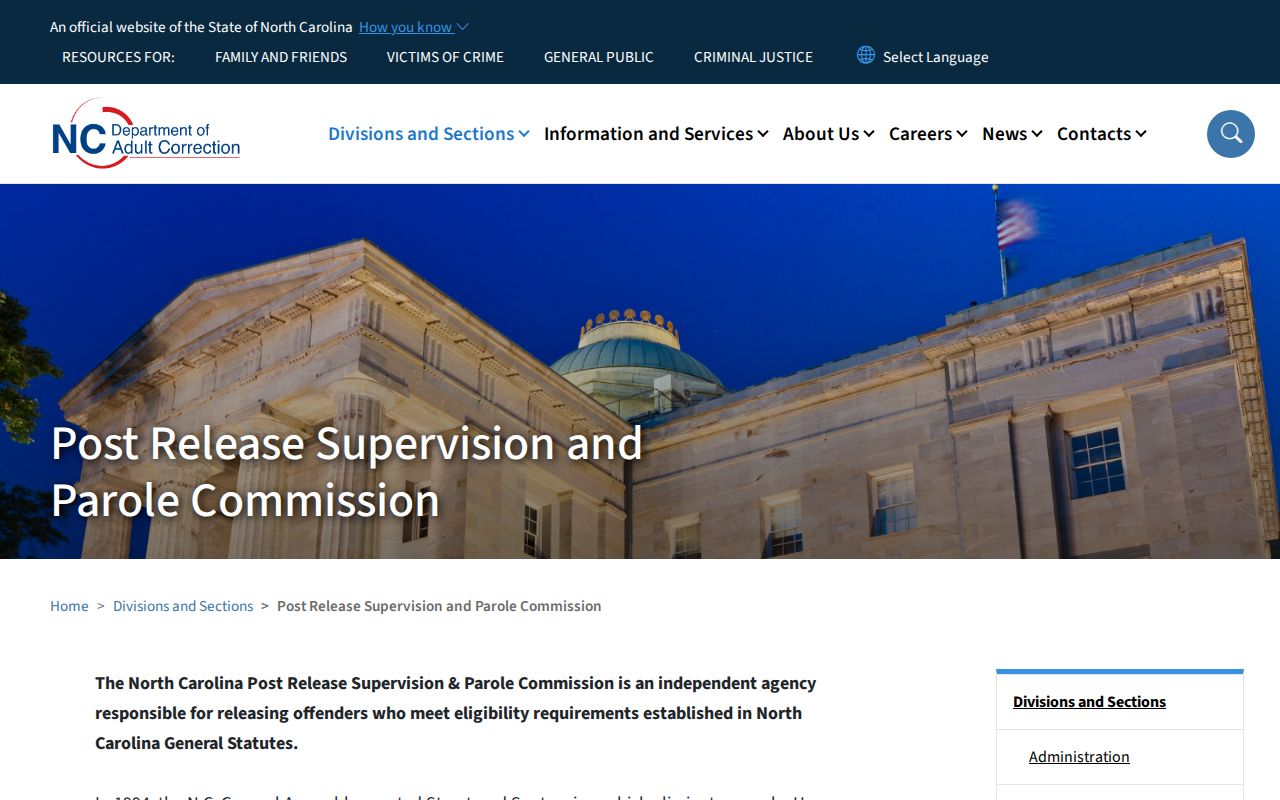
The image reinforces that ordinary review is conducted through Commission files rather than a courthouse-style personal hearing.
Property After Henderson County Release
Supervision and property return are handled through different channels. The Henderson County Sheriff distinguishes ordinary arrest property from evidence. Wallets, keys, and other personal items held with a person at arrest are normally stored at the Detention Center. The Sheriff says ordinary property is normally released on Wednesdays, and the Detention Center can be reached at 828-694-3091.
Evidence follows a stricter path. According to the HCSO Evidence and Property instructions, a judge-signed release order is required before HCSO evidence can be returned. A certified dismissal alone is not enough. After the order, the person schedules an Evidence/Property appointment at 828-694-3139. These steps do not change parole, probation, or PRS status, but they can matter during the practical transition from jail custody to community supervision.
Do not send a supervisee to an unverified reporting address while resolving property. The jail handles ordinary arrest property, Evidence/Property handles evidence after a court order, and NCDAC supplies supervision instructions. Keeping those offices separate prevents a missed report or an unnecessary trip.