
ICE Custody Release Paths
Immigration custody is federal custody. A person may leave Henderson County Detention Center for the community, for another jail, or for ICE. The word “release” on a county event can describe the end of the HCSO booking even when a receiving agency immediately takes custody. The release disposition and destination are therefore essential.
ICE can later release a person under its own process, continue detention at another location, transfer the person, or carry out another immigration action. Those outcomes cannot be inferred from HCSO app absence. An ICE locator result is also limited to the ICE system and its stated time window. Court cases, bonds, and orders may add context, but the agency holding the person confirms the operational event.
Confirm an ICE Custody Release
The official ICE Online Detainee Locator System supports two exact-match methods. Use a nine-digit A-number with country of birth, or enter the person’s exact name and country of birth. A shorter A-number must be padded with leading zeros until it has nine digits.
- Ask HCSO whether the person left for the community or was transferred to ICE.
- Use the exact nine-digit A-number when it is known and add the correct country of birth.
- If no A-number is available, enter the full name exactly and try documented name forms.
- Read the displayed custody or location result without expanding it beyond the ICE system.
- Contact the relevant ICE Enforcement and Removal Operations office when the locator cannot resolve a current case.
An absent locator result is inconclusive. Exact-match problems, data lag, age rules, transfer, or an event outside the locator window may explain it.
ICE Release Search Coverage
ICE describes ODLS as a tool for people in current ICE custody or in Customs and Border Protection custody for more than 48 hours. Its attorney guidance also describes people released from ICE custody within the prior 60 days. That recent-release period is not a Henderson County 60-day archive and should not be turned into a promise that every former detainee will appear.
| Search item | Requirement or meaning |
|---|---|
| A-number | Use nine digits, adding leading zeros when needed |
| Country of birth | Required with either ODLS search route |
| Name | Must match ICE data closely |
| Custody result | Reports the ICE or covered CBP record, not county or state custody |
| No result | Does not by itself prove release |
People younger than the locator’s covered age, recently transferred people, and records with spelling differences can be hard to find. Preserve the exact search values and time checked before asking ERO to help resolve the identity.
Match the A-number and country of birth before relying on a result. When only a name is available, record every exact spelling tried. If HCSO names ICE as receiver but ODLS returns nothing, give ERO the county booking date, transfer date, identity details, and A-number when known. The mismatch may reflect timing or coverage rather than release.
Henderson ICE Transfer Records
HCSO holds the local booking and local release or transfer record. For a recent disappearance from the county app, call Henderson County Detention Center at 828-694-3091 and ask whether the person remains held, was released to the community, or was sent to a named agency. HCSO Records at 828-694-3128 can receive a focused request for the existing booking and release sheet.
A useful request includes the full name, aliases, date of birth, booking number when known, and approximate dates. Ask for the booking date and time, release date and time, release authority or type, and transfer agency or destination where public. The Henderson County released-inmate search path also shows how court records and VINELink can corroborate the local event. Neither source replaces the actual custodian’s record.
Henderson 287(g) Release Context
Henderson County has a documented HCSO and ICE 287(g) Jail Enforcement Model agreement dated 2020. The agreement supports a real local transfer pathway. It should be dated whenever cited because an older agreement does not establish the current treatment of every person or prove a particular transfer.
The HCSO 287(g) Steering Committee page supplies county program context. For a person-level question, use HCSO’s release disposition and ODLS or ERO confirmation. Avoid stating that a person “was released” when the record means only that the county booking ended. “Transferred to ICE custody,” when supported, preserves the material distinction.
The official county page can also be seen in the matching project capture.
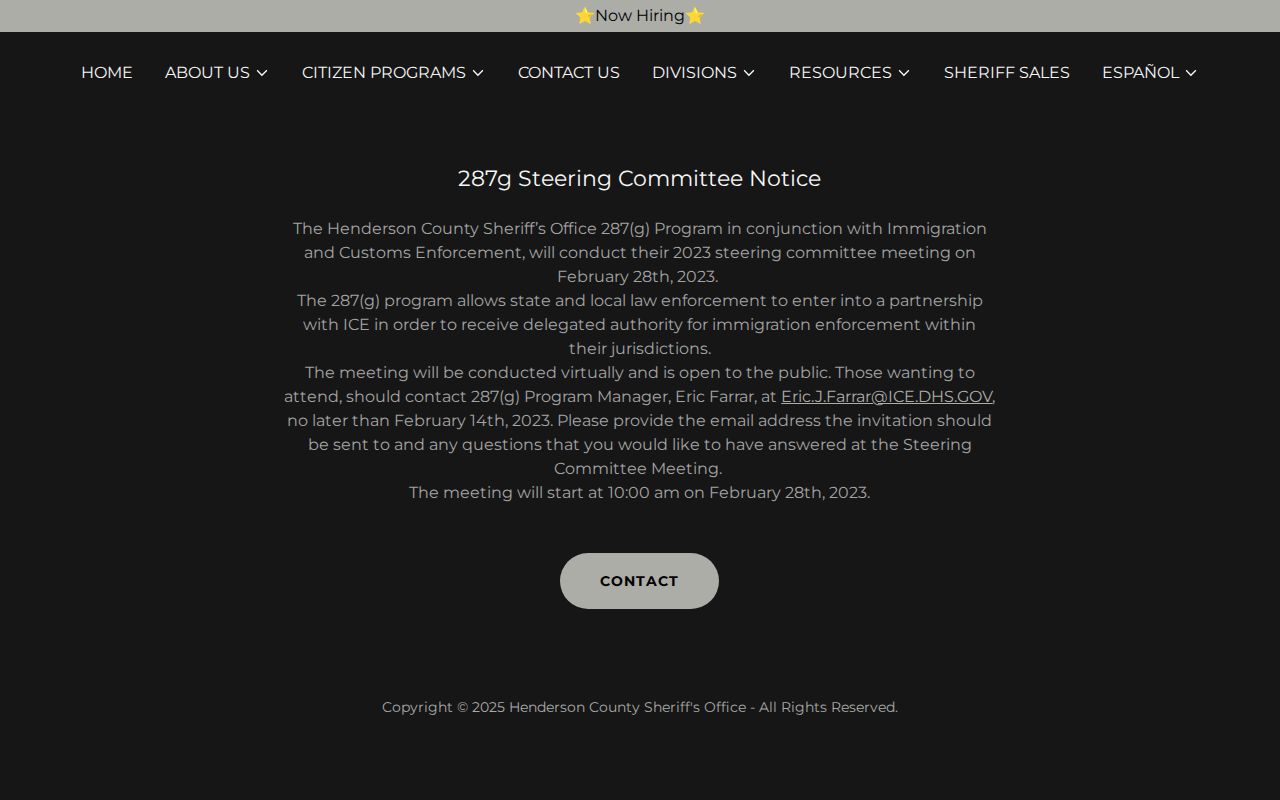
The county source documents the local 287(g) context, while the person’s current custody still requires an episode-specific official check.
ICE Custody Release Records
ODLS is a status and location tool, not a complete immigration file. When documentary proof is needed, identify the exact record and the agency that created it. An HCSO transfer sheet belongs with the Sheriff. An ICE custody or release record belongs with the relevant federal component. A court order belongs with the immigration or federal court that issued it.
A focused records request should identify the person by full name and A-number, specify the custody dates, and name the release, transfer, or detention record sought. Privacy rules can limit third-party access. Requesters should not expect an agency to create a new account of the case. Ask for separable, nonexempt portions if a record contains both releasable and protected information.
- A-number
- The immigration identification number used to match a person in ICE records.
- ERO
- Enforcement and Removal Operations, the ICE component that manages detention and related field operations.
- Transfer
- A change from one custodian to another, not release into the community.
- Detainer
- A request or legal mechanism tied to another authority’s custody interest.
ICE Versus Other Releases
County, state, federal prison, and immigration searches are not interchangeable. HCSO documents the local booking. NCDAC tracks North Carolina state prison and community-supervision history. BOP covers federal prison custody. ICE ODLS covers the immigration detention scope stated by ICE. A person can appear in more than one system at different points.
| Custody question | Primary source |
|---|---|
| Did the person leave Henderson County jail? | HCSO Detention and release record |
| Did NCDAC receive the person? | NCDAC Offender Search |
| Was the person in federal prison? | BOP Inmate Locator |
| Did ICE assume or retain custody? | ODLS and ERO |
| What did a court order? | The issuing court’s official file |
A court disposition can explain legal authority but does not supply the jail door-out time. VINELink can provide a participating agency’s event notice, yet it may lag and does not rule out another custodian.
Henderson Detention Expansion Context
The Henderson County Detention Center opened in 2001 with 222 beds. Its secure enclosed connection to the courthouse allows a detainee to attend court without leaving custody. The current Judicial Center Addition and Renovation project includes detention expansion alongside courthouse construction, but that work does not establish any change to release hours, waiting locations, or ODLS reporting.
A 2021 county facility study described the former work-release space as repurposed for transport offices, volunteers, and storage. It should not be presented as an active work-release or immigration release facility. These local facts explain the physical custody setting. They do not replace a person-level HCSO record or ICE search.
Note: Call the current custodian before traveling because Henderson release exits, family waiting rules, and ICE transfer timing are not published.
Henderson ICE Release Follow-Up
An ICE release result should be recorded with the exact wording, agency, search values, and observation time. Then compare it with the HCSO transfer record. A county timestamp marks the end of the local episode; an ICE timestamp marks an immigration event. They need not match because transport, intake, database updates, and later ICE action occur at different points.
If ODLS returns no result, repeat exact name forms and check the A-number format before escalating. A record may fall outside the recent-release window, involve a person below the locator’s covered age, contain a spelling difference, or lag after transfer. Contact ERO with the identity and custody details already gathered. Record the ERO office and contact time. Do not substitute the NCDAC or BOP locator because those systems cover state prison and federal prison, not ICE detention.
When a court order appears relevant, obtain it from the issuing court and keep its role narrow. The order can explain authority, conditions, or a case outcome. It cannot establish the moment that HCSO or ICE physically released or transferred the person. The responsible custodian’s event record remains the operational proof. Save both event times when the distinction affects travel, notification, or a records request.